When Proof Is Not the Same as Truth
 Wendy Apple
Science, Intuition, and the Long Way Around to Knowing
This is a longer reflective essay written to clarify my own understanding of how I arrived at my current work and direction. It’s not a how-to or a summary, but a thinking-through of lived experience, science, intuition, and growth. If you’re interested in how I approach healing, creativity, and teaching, this piece offers that context.
I was raised by intellectuals who believed that learning how to think mattered far more than learning what to think. Questioning assumptions was encouraged. Evidence mattered. Precision mattered.
Where that upbringing erred, and it took me a long time to see this, was in teaching me that there was always one truth, one correct answer waiting to be discovered if I just thought hard enough. Unlearning that assumption turned out to be far more difficult than learning critical thinking ever was.
That early formation shaped everything that came after.
It meant I was never especially interested in belief systems that required allegiance or certainty. At the same time, I struggled deeply when life refused to conform to a single, tidy explanation. What I wanted - what I still want - are ways of listening more clearly: to my body, my inner world, and the subtle signals that tell the truth long before the mind can organize it.
Over time, a number of influences found their way into my life. Not all at once. Not neatly. Some arrived through crisis. Some through practice. Some through quiet, persistent resonance. Together, they form the ground I stand on when I teach, even when I’m not naming them explicitly.
These are not methods I teach.
They are ways I learned to pay attention.
My long journey with illness and healing brought this into sharp focus. When I developed chronic neurological Lyme disease, my symptoms were real, debilitating, and life-altering, yet often questioned or dismissed because they could not be clearly confirmed by existing diagnostic tools. According to many “hard science” standards at the time, if something could not be measured or seen under a microscope, it was treated as suspect, or not real at all.
I learned firsthand that the absence of proof is not the absence of truth. More often, it reveals the limits of our current understanding.
That realization changed how I relate to what I believe.
Long before my health crisis reached its most extreme point, I had already begun questioning the idea that reality must fit neatly inside established frameworks. The death of my son forced me to reevaluate how meaning, loss, and growth coexist. Later, years of illness taught me something even more fundamental: lived experience carries its own form of intelligence, whether or not we yet have language or tools to explain it.
As my health slowly stabilized, I became more willing to trust direct experience - not uncritically, but honestly. If something shifted my nervous system, my perception, or my inner life in a tangible way, I allowed that experience to matter, even when I couldn’t yet explain how or why it worked.
This shift deeply shaped my creative and healing journey.
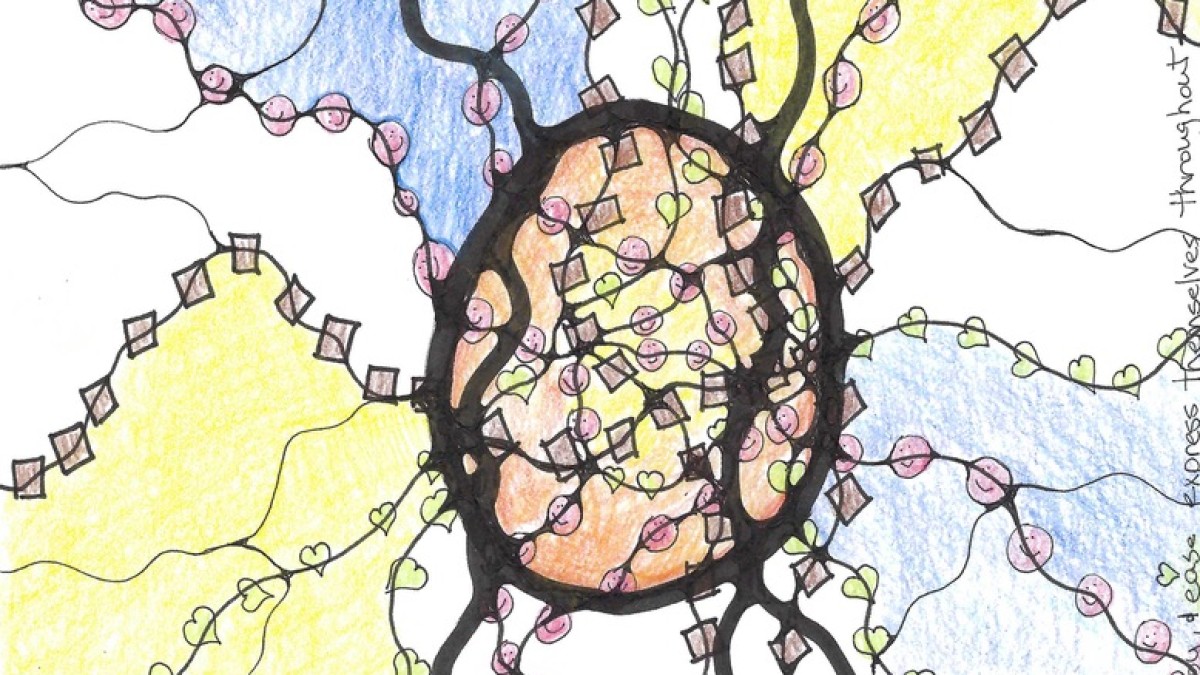
Time spent putting colored pencil, marker, pencil, and even brush to paper became less about creating something beautiful and more about listening. I shifted from trying to make something beautiful to listening to my intuition through the marks on the page. Line, color, and form became a way to regulate my nervous system, process experience, and stay in relationship with myself.
When I discovered NeuroGraphica®, it felt like the missing piece I had been searching for. From my very first drawing, I recognized it as a bridge between conscious intention and unconscious wisdom. It offered structure without requiring performance, and process without judgment. Through NeuroGraphica®, I learned a disciplined way to work with intuition, sensation, and meaning on the page - without needing to be an artist, or even particularly tidy.
I am deeply grateful for the people who carried this work to me and walked alongside me as I learned it. I honor Pavel Piskarev, the author of the NeuroGraphica® method, whose original vision made this work possible. I am thankful for my teachers - Anna Romanenko, Natalia Kolev, Tatiana Yu, and Anna Denning - who were not only teachers, but translators. They translated not just words from Russian into English, but meaning, context, and worldview—helping bridge cultural differences so this work could be understood and practiced by an American audience.
The work didn’t stop there. Through ongoing dialogue and shared practice with my fellow travelers - Kate Dixon, Melba Warren, and Monique Doyon - those translations were further refined. Together, we explored how these ideas actually land in American bodies, lives, and language, turning direct translation into lived understanding.
Two recent blog posts by Anna Denning - one on the origins of NeuroArt and the NeuroArts, and another comparing Zentangle, NeuroGraphica, and the Art of Manifesting Method - prompted me to pause and reflect on how my own understanding has evolved. Her writing articulated distinctions I had been sensing intuitively for years and gave language to differences that matter.
Along the way, I was also informed by exposure to other drawing-based practices, including Zentangle. While I did not formally study that method, the experience contributed to my broader understanding of how simple, repetitive mark-making can support focus, regulation, and presence.
I remain genuinely grateful for the structure and discipline NeuroGraphica® brought into my life. It supported a profound expansion in my understanding of healing, embodiment, and inner transformation. It marked a pivotal stage in my journey - and I honor that fully.
And yet, growth does not end with gratitude.
There comes a point in any long healing journey when a container that once supported expansion begins to feel constraining. I recognize this pattern because I have lived it before. Just as rigid reliance on “hard science only” once limited my ability to trust my own experience, I now feel that increasingly narrow definitions, rules, and boundaries no longer support the direction my intuition and inner work are leading me.
This does not make those structures wrong.
They served a purpose.
They helped me grow.
But they are no longer sufficient.
Healing, creativity, and consciousness do not move in straight lines. They wind. They evolve. They ask us to loosen certainty and step into wider fields of possibility. Continuing to grow sometimes means releasing frameworks we once needed, without denying their value or our gratitude for them.
This is where I find myself now.
WendingPath reflects this ongoing evolution. It is an expression of everything I have learned through grief, illness, recovery, creative practice, and teaching. It honors structure without being confined by it. It values science while acknowledging its current limits. It trusts lived experience, embodied knowing, and intuition as legitimate sources of wisdom.
I no longer need everything to be proven to accept it as reality.
I need it to be lived, integrated, and true.
And I trust the path to keep unfolding as I continue to listen.